
Why is a 100% Billable Utilization Rate a Sign of Operational Failure?

Updated: Mar 25

In the traditional consulting model, a 100% billable utilization rate is often treated as the ultimate signal of operational health. Dashboards glow green. Leaders feel reassured. Capacity looks “fully optimized.”
But as we move into 2026, experienced professional services leaders are seeing this metric differently—and more honestly.
A fully utilized team isn’t efficient. It’s fragile.
When every available hour is pre-sold, your firm has no margin for change, no room to think, and no buffer when reality intervenes. What looks productive on paper becomes a single-point-of-failure operating model in practice.
The Fragility Trap of a 100% Billable Utilization Rate
When your team is red-lined at maximum capacity, you have zero innovation liquidity.
That liquidity—mental bandwidth, schedule flexibility, and decision space—is what allows firms to respond when:
A client changes scope unexpectedly
A delivery timeline slips
A key team member gets sick or leaves
A high-value strategic opportunity appears
If every hour is already sold, even a minor disruption can trigger a domino effect across delivery, morale, and margins.
This is the same dynamic ALTA highlights in our work on capacity planning constraints that emerge as firms grow past early scale, where utilization pressure compounds instead of easing as teams expand. When firms ignore capacity elasticity, growth creates stress—not leverage.
Why Peak Utilization Breaks Down at Scale
A 100% billable utilization rate assumes a world that rarely exists:
Perfect project forecasting
No rework
No internal collaboration
No training or improvement time
No selling, thinking, or innovating
In reality, professional services firms rely on context switching, judgment, and relationship-driven work. These activities don’t fit neatly into a utilization model—but they are exactly what differentiates strong firms from commodity providers.
When utilization targets ignore this reality, three things happen:
Margins become brittle One delay or write-off can erase months of “efficient” delivery.
Teams burn out quietlyNon-billable work doesn’t disappear—it gets pushed into evenings and weekends.
Growth stallsLeadership has no capacity to pursue new markets, offerings, or partnerships.
This is closely tied to the broader resource gap between marketing, sales, and delivery that ALTA often sees in growing firms—where everyone is busy, yet the firm struggles to create forward momentum.
The Goldilocks Zone: 70–80% Utilization
The most resilient firms don’t aim for maximum utilization. They aim for intentional slack.
A 70–80% billable utilization rate creates a Goldilocks Zone—enough productivity to protect margins, but enough capacity to absorb change without chaos.
This buffer allows firms to:
Onboard new work without panic staffing
Handle scope shifts without margin erosion
Invest in sales, improvement, and innovation
Protect team energy and judgment
Counterintuitively, this model often outperforms high-utilization firms financially over time—because it reduces rework, churn, and leadership drag.
Protect the Pivot with Scenario Planning
Slack without visibility is waste. Slack with insight is leverage.
High-performing firms pair lower utilization targets with scenario planning—running “what-if” simulations before problems hit.
Effective scenario planning helps leaders see:
How a two-week project delay affects downstream capacity
Where a single staffing change creates cascading risk
Which accounts create the most volatility
This is especially important as firms grow and leaders can no longer “feel” capacity intuitively. The firms that scale best replace gut feel with clear operating signals.
Shift from Reactive to Predictive Demand Planning
Many firms manage utilization reactively—filling gaps after they appear.
Predictive firms do the opposite.
By using live capacity indicators, leaders can spot resource bottlenecks 60–90 days in advance, allowing time to:
Adjust sales pacing
Rebalance teams
Hire proactively instead of urgently
This mindset shift mirrors how strong sales teams create more selling time by removing last-minute fire drills and administrative drag.
Capacity planning isn’t just an operations issue. It’s a growth strategy decision.
Identify Revenue Leakage Before It Compounds
Not all billable hours are equal.
Without real-time visibility, firms often over-invest in work that:
Looks billable
Feels productive
But delivers low strategic or financial return
Heatmaps and workload analysis help leaders distinguish between:
High-impact billable work that drives client outcomes
“Non-billable noise” that quietly erodes profitability
This clarity allows firms to protect margins without squeezing people harder, a critical leadership signal in a market where talent retention matters as much as utilization math.
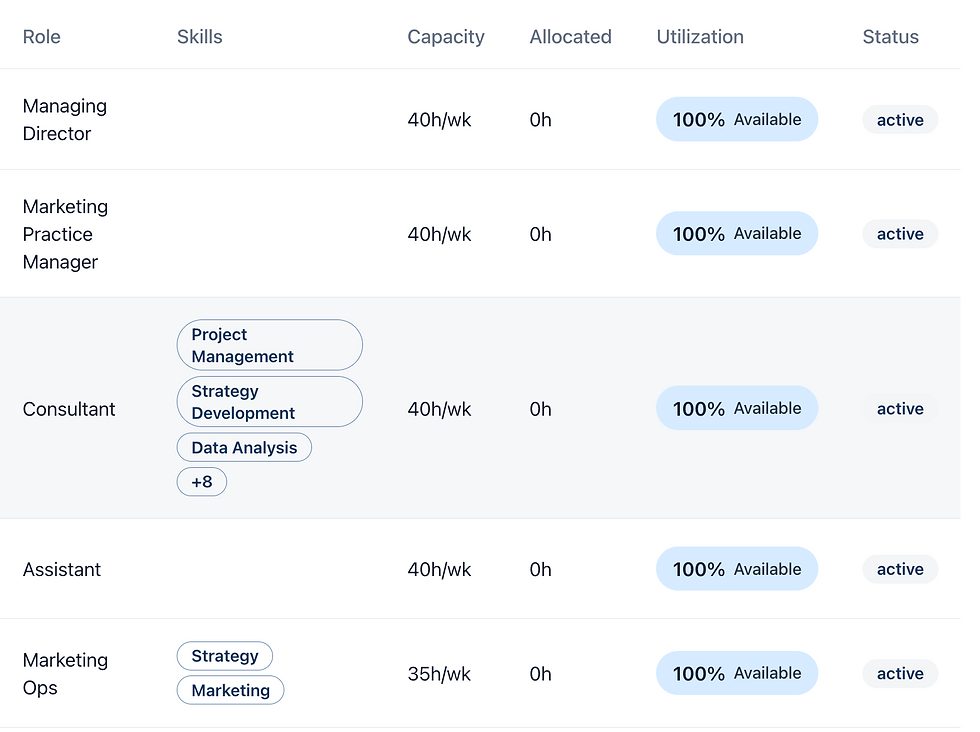
Space Is Not Lost Revenue; It’s Strategic Insurance
Creating intentional capacity isn’t about leaving money on the table.
It’s about protecting the firm’s ability to respond intelligently when conditions change.
Firms that operate with zero slack:
Say no to good opportunities
Over-promise under pressure
Damage reputation through rushed delivery
Firms that protect innovation liquidity can say yes, confidently, sustainably, and without burning trust.
The real question for leaders isn’t: “Are we fully utilized?”
It’s:“Do we have the capacity to pivot without breaking?”
Build Capacity That Supports Growth—Not Fragility
At ALTA Consulting, we’ve spent years helping professional services leaders design operating models that balance utilization, agility, and growth. And we kept seeing the same problem.
Firms weren’t failing because they lacked talent or demand.
They were failing because leaders couldn’t see capacity clearly enough to make confident decisions.
Utilization dashboards looked strong.
Teams felt stretched.
Growth felt harder than it should.
That’s why ALTA created Leverage.
Leverage was built to help leaders move beyond static utilization metrics and gut feel—and instead understand their firm’s true capacity and innovation liquidity in real time.
With Leverage, firms can:
See how much capacity they actually have to absorb change
Model the impact of new work before committing to it
Identify where utilization pressure is quietly creating delivery, margin, or burnout risk
Create intentional space for sales, improvement, and strategic growth
High utilization isn’t the real issue. Lack of innovation liquidity is.
The firms that scale without burning out their teams understand exactly how much flexibility their operating model allows, and protect it intentionally.
If your utilization metrics look healthy but your firm feels fragile, that tension is worth exploring. 👉 See how Leverage makes capacity visible—so you can scale with confidence, not guesswork
Because capacity isn’t lost revenue. It’s what makes growth possible.


https://go99.gives/ ừ mình cũng có lướt qua tí thôi. Ban đầu cứ nghĩ kiểu sẽ rối mắt như nhiều trang cùng dạng, ai ngờ bố cục lại khá dễ chịu, kéo xuống không bị ngộp và nhìn là biết chỗ nào là phần chính; mình không đọc kỹ nội dung đâu, chủ yếu xem cách họ bày ra sao với thông tin hiện theo từng đoạn thế nào khi cuộn trang. Cái mình thích là thanh menu để ngay chỗ dễ thấy nên đổi qua lại nhanh, khỏi phải mò, với mấy khối nội dung dạng ô/ danh sách đặt cạnh nhau nên mắt quét phát là nắm được ý, không phải dừng lại lâu. Nói chung chỉ là cảm…
socolive tv nghe mọi người bàn cũng nhiều nên mình ghé thử cho biết, lúc đầu vẫn hơi lăn tăn kiểu sợ vào là bị ngợp vì chữ nghĩa với nút bấm loạn xạ như vài trang khác, nhưng lướt qua một vòng thì thấy họ trình bày khá dễ theo dõi, mấy khối nội dung đặt tách bạch nên nhìn phát hiểu đang ở phần nào, không phải căng mắt tìm. Mình không đọc sâu đâu. Chỉ thử chuyển qua lại vài mục. Thấy thanh menu để ngay chỗ dễ nhìn nên thao tác nhanh. Các bảng thông tin dạng cột cũng gọn, căn lề thoáng nên không bị rối mắt, nhìn vẫn rõ từng dòng.
Game bài đổi thưởng mình vừa tò mò bấm vào xem thử, ai dè trang mở ra là gặp ngay thông báo lỗi “404 Not Found” to đùng giữa màn hình. Ban đầu tưởng mạng chập chờn, nhưng đọc dòng giải thích kiểu “tài nguyên yêu cầu không tìm thấy trên server” là hiểu ngay do mình vào nhầm chỗ chứ không phải lag. Cũng phải công nhận trang báo lỗi nhìn gọn gàng, chữ rõ ràng nên không bị rối mắt hay khó chịu. Kéo xuống dưới còn thấy dòng “Proudly powered by LiteSpeed Web Server” quen quen như mấy site chạy LiteSpeed hay để vậy. Nói chung không xem được nội dung thì hơi hụt, nhưng ít nhất…
https://fv888.io/ hôm trước mình thấy bạn bè nhắc nên bấm vào nghía thử cho biết thôi. Mình không ngồi đọc kỹ hay làm gì nhiều, chủ yếu xem giao diện có dễ nhìn không. Ấn tượng đầu là trang sắp xếp khá gọn, kiểu nhìn một cái là biết chỗ nào ra chỗ đó, không bị rối mắt. Mình để ý cái menu đặt khá lộ, nên chuyển qua lại giữa mấy phần nhanh, không phải mò lâu. Màu nền với chữ cũng vừa phải, không kiểu chói loá làm mỏi mắt như vài trang khác mình từng lướt. Nói chung lướt vài phút là quen tay, vì các khối nội dung và thanh menu điều hướng được đặt khá…
QS88 dạo này thấy bạn bè nhắc hoài nên mình cũng bấm vào coi thử cho biết thôi. Mình không có ngồi tìm hiểu sâu hay chơi gì, chỉ lướt vài phút xem giao diện có dễ chịu không. Cảm giác đầu tiên là trang nhìn thoáng, chia nội dung thành từng mảng rõ ràng nên mắt bắt nhịp nhanh, không bị kiểu chữ dồn dập khó đọc. Mình cũng thích cái menu để ngay chỗ dễ thấy, chuyển qua lại vài mục khá mượt, không phải mò lâu mới ra. Nói chung lướt trên điện thoại cũng ổn, không bị rối hay quá nhiều thứ nhảy vào mặt. Điểm mình ấn tượng nhất vẫn là cách họ chia khối…